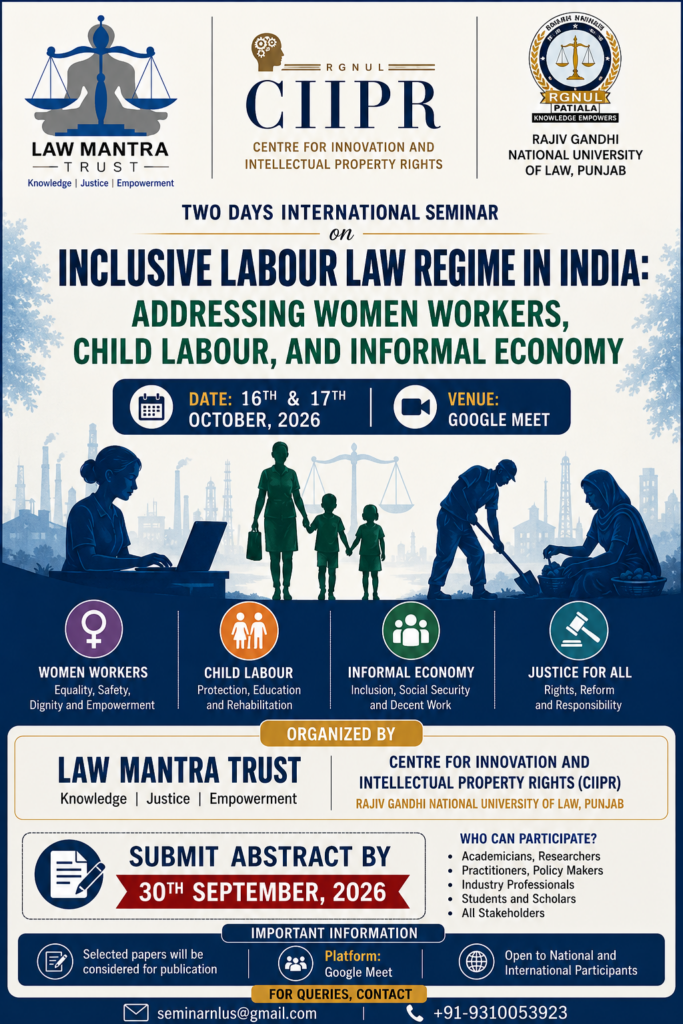
TWO DAYS INTERNATIONAL SEMINAR
ON
“INCLUSIVE LABOUR LAW REGIME IN INDIA: ADDRESSING WOMEN WORKERS, CHILD LABOUR, AND INFORMAL ECONOMY”
DATE: 16TH & 17TH October, 2026
ORGANIZED BY
LAW MANTRA TRUST
CENTER FOR INNOVATION AND INTELLECTUAL PROPERTY RIGHTS (CIIPR)
RAJIV GANDHI NATIONAL UNIVERSITY OF LAW, PUNJAB
VENUE: GOOGLE MEET
ABOUT THE ORGANISERS
About Law Mantra Trust: “Law Mantra” (headquarters New Delhi) (Registration No 150 in Book No.4 Vol No 3, 603 0f 2018) is not for profit organization running for the purpose of enhancing legal academics and legal awareness in society and in the practice of the same. Law Mantra is a registered society under the Indian Trust Act, 1882 whose members are leaders and members from the legal fraternity, other professions with a nexus to conflict resolution, academics and experts from various fields who are committed to resolving conflicts and disputes using innovative mechanisms and methods such as Mediation, Conciliation, Negotiations and Arbitration. Law Mantra is a body of Jurists, Advocates, Academicians and Students running for the purpose of enhancing legal academics and legal awareness in society and in the practice of the same.
About Center for Innovation and Intellectual Property Rights (CIIPR) Rajiv Gandhi National University of Law, Punjab:
The Rajiv Gandhi National University of Law (RGNUL) was established by the State Legislature of Punjab through the Rajiv Gandhi National University of Law, Punjab Act, 2006 (Punjab Act No. 12 of 2006). The act aimed to establish a university of law of national stature in Punjab, to fulfill the need for a center of excellence in legal education during the era of globalization and liberalization. Currently, RGNUL is recognized as one of the top-ranking law teaching institutions in the country, providing over 1000 students with state-of-the-art legal education on a modern, fully developed residential campus equipped with all necessary infrastructure and manpower facilities to facilitate their all-around growth. RGNUL is committed to promoting research, training, and consultancy in various areas of contemporary interest, with a vision to become a researchintensive university in the future. To this end, the university has established 19 research centers focusing on various areas of social-legal inquiries, including the Center for Innovation and Intellectual Property. Through these centers, the university aims to contribute significantly to the development of legal research and knowledge in India and beyond. RGNUL is a premier institution of legal education in India, committed to providing high-quality legal education and promoting research and innovation in various areas of contemporary interest. With a state-of-the-art campus, a team of experienced faculty members, and a commitment to excellence, RGNUL is CIIPR Website Content 4 well-positioned to continue its growth and development as a leader in legal education in India and beyond. Vision of RGNUL “Our endeavour is to serve the society through reforms in legal services by way of preparing professionally competent lawyers, inquisitive researchers, able administrators, conscientious judicial of icers, and above all, socially responsible citizens, who shall be whole- heartedly and continuously engaged in the process of nation building.”
CIIPR aims at teaching and promoting research in the IPR specialization course which is to synergize all types of IPRs in all the fields of sciences, technologies, engineering and another field of studies and further promote innovations in the interest of all the stakeholders. RGNUL, Punjab has itself been established as the Nodal Center of Academics and Professionalism in legal education and is yet to establish itself in specialising in Intellectual Property Clinics (IP Clinics). Efforts by RGNUL to create enabling milieu by way of modernizing the IPR infrastructure as well as implementing various programs for the creation of awareness among the professionals as well as general public will be a mile stone of success.
CONCEPT NOTE
Labour is the foundation of economic growth and social development. A fair and inclusive labour law regime not only safeguards the rights and dignity of workers but also contributes to sustainable economic progress and social justice. India has witnessed significant reforms in labour legislation through the consolidation of numerous labour laws into four Labour Codes. While these reforms seek to simplify compliance and improve the ease of doing business, they also raise important questions regarding the protection of vulnerable sections of the workforce, particularly women workers, children, and those employed in the informal economy.
India’s workforce is one of the largest and most diverse in the world. However, a substantial proportion of workers continue to remain outside the ambit of effective legal protection and social security. Nearly ninety percent of the workforce is engaged in the informal economy, where employment is often characterised by low wages, lack of written contracts, unsafe working conditions, absence of social protection, and limited access to justice. Informal workers—including domestic workers, construction workers, agricultural labourers, home-based workers, street vendors, migrant workers, and gig and platform workers—continue to face multiple legal and socio-economic vulnerabilities despite several welfare initiatives.
Women workers constitute an indispensable part of India’s labour force and play a vital role in both the formal and informal sectors. Nevertheless, they continue to experience persistent barriers such as unequal wages, occupational segregation, workplace discrimination, sexual harassment, inadequate maternity and childcare support, and low labour force participation. The increasing participation of women in digital and platform-based employment has further highlighted the need for labour laws that are responsive to emerging forms of work while ensuring equality, dignity, safety, and social security.
The issue of child labour continues to pose a serious challenge to the realization of constitutional values and human rights. Although India has enacted comprehensive legislation prohibiting child labour and has committed itself to various international conventions, economic deprivation, inadequate access to education, migration, trafficking, and social inequalities continue to push children into exploitative forms of labour. Eliminating child labour requires not only effective legal enforcement but also coordinated efforts in education, rehabilitation, poverty alleviation, and community participation.
The changing nature of employment driven by technological innovation, digitalisation, artificial intelligence, automation, and platform-based work has introduced new dimensions to labour regulation. These developments call for labour policies that strike a balance between economic competitiveness and workers’ rights while ensuring decent work, social protection, occupational safety, and equitable opportunities for all.
In this context, the Two-Day International Seminar on **”Inclusive Labour Law Regime in India: Addressing Women Workers, Child Labour, and Informal Economy”** seeks to create a vibrant academic platform for dialogue among scholars, judges, policymakers, legal practitioners, labour administrators, researchers, representatives of industry, trade unions, civil society organisations, and students from across the globe. The seminar aims to facilitate critical discussions on contemporary labour law reforms, constitutional and human rights perspectives, international labour standards, comparative experiences, and emerging challenges affecting vulnerable workers.
The seminar also seeks to encourage interdisciplinary research that contributes to the development of an equitable, rights-based, and inclusive labour law framework capable of responding to the changing realities of work. By bringing together diverse stakeholders, the seminar aspires to generate meaningful policy recommendations and innovative legal solutions that strengthen labour governance and promote social justice in India and beyond.
OBJECTIVES OF THE SEMINAR
The seminar seeks to achieve the following objectives:
- To examine the evolving labour law regime in India in light of recent legislative reforms and changing patterns of employment.
- To analyse the legal and policy challenges relating to women workers, child labour, and workers engaged in the informal economy.
- To promote discussions on gender equality, decent work, social security, occupational safety, and workplace dignity.
- To evaluate the effectiveness of existing legal mechanisms for preventing child labour and protecting children’s rights.
- To explore the impact of technological advancements, digital labour platforms, and artificial intelligence on employment relations and labour rights.
SUB-THEMES
The seminar invites original research papers on the following themes. The list is indicative and not exhaustive.
- Labour Law Reforms and Inclusive Governance
- Labour Codes and their implementation
- Constitutional protection of labour rights
- Labour administration and regulatory reforms
- Access to justice in labour disputes
- Future of labour law in India
- Women, Work and Gender Equality
- Equal remuneration and wage justice
- Maternity benefits and work-life balance
- Prevention of sexual harassment at the workplace
- Women in the informal and gig economy
- Leadership, representation, and economic empowerment
- Care work and unpaid labour
- Child Labour and Protection of Children’s Rights
- Legal framework on child labour
- Child trafficking and bonded labour
- Right to education and child protection
- Rehabilitation and social reintegration
- Child labour in global supply chains
- International perspectives on child rights
- Informal Economy and Social Protection
- Rights of informal sector workers
- Migrant workers and labour mobility
- Domestic workers and home-based workers
- Street vendors and construction workers
- Gig and platform workers
- Universal social security and labour welfare
- Occupational Safety, Health and Welfare
- Occupational safety and health standards
- Workplace dignity and employee well-being
- Mental health in the workplace
- Social security and welfare legislation
- Safe and healthy working environments
- Technology, Digital Economy and the Future of Work
- Artificial intelligence and employment
- Platform-based work and labour regulation
- Digital surveillance and employee privacy
- Automation and job security
- Emerging employment relationships
- International and Comparative Labour Law
- International Labour Organization (ILO) standards
- Comparative labour law reforms
- Business and human rights
- Global supply chains and labour compliance
- Sustainable Development Goals and labour rights
- Labour Dispute Resolution and Industrial Relations
- Collective bargaining and trade unions
- Industrial relations in changing workplaces
- Mediation and arbitration in labour disputes
- Labour courts and industrial tribunals
- Online dispute resolution in employment matters
- Contemporary Issues in Labour Law
- Climate change and labour migration
- Green jobs and just transition
- Corporate accountability and ESG
- Labour rights and human dignity
- Emerging challenges in employment law
Authors are also welcome to submit papers on any other contemporary issue related to labour law, industrial relations, employment policy, women workers, child labour, social security, labour welfare, human rights, or allied interdisciplinary areas that are consistent with the central theme of the seminar.
Law Mantra Trust invites academicians, researchers, legal professionals, policymakers, and students to participate and share their research papers on the seminar’s theme and sub-themes. Selected papers will be published in an edited book with an ISBN, and the copyrights will remain with the authors and Law Mantra Trust.
Procedure for Submission of Abstracts:
- The abstract (of about 250 words) should be sent as an attachment in a Word file. Abstracts will be peer-reviewed before they are accepted.
- The following information, in the given format, should be sent along with the Abstract:
- Name of the Participant, Official Designation/Institution Details, Address and Email ID, Title of Abstract.
- Submit your abstract to [email protected]
- Guidelines for Paper Submission and Other Guidelines:
- The title of the paper should be followed by Name, Designation, Name of the Organization / University / Institution and Email address. It is mandatory to mention the Email address, as all future correspondence will be through it;
- Name and details of Co-author, if any;
- Chapter: Chapter should be in Times New Roman 12 point font and double spaced. Main Title should be in full capitals, bold and centered 12 point font. Sub-titles should be in sentence case, bold and 12 point font. Author’s names should be in small capitals and centered 12 point font Footnotes should be in Times New Roman 12-point font;
- Citation Format: Please use footnotes rather than endnotes. Footnotes should conform to The Indian Law Institute, New Delhi Style;
- Submission of the abstract: A cover letter with the name(s) of the author(s) and address, designation, institution/affiliation, the title of the manuscript and contact information (email, phone, etc.) is compulsory to submit. All submissions must contain an abstract of not more than 300 words with 5 Minimum Keywords;
- Originality of Manuscripts: All the contributions should be the original work of the contributors and should not have been submitted for consideration in any other Publication. Any plagiarized work will be out-rightly rejected;
- Copyright: The contributions presented to and accepted for publication and the copyrights therein shall be the Intellectual Property of Law Mantra;
- The title of the Chapter should be followed by Name, Designation, Name of the Organization / University / Institution and Email address. It is mandatory to mention the Email address, as all future correspondence will be through it;
- Name and details of Co-author, if any;
- The paper should be typed in MS WORD format (preferably 2007 or 2010);
- The paper must be in single column layout with margins justified on both sides;
- The length of the paper should not be below 4,000 words (including footnotes) and Should not Exceed more than 10,000 (Including Footnotes).
- Registration Fee for the Student category is Rs 800 (Per Individual) and for Faculty/Professional/Research Scholar/Other is Rs 1200 (Per Individual). Both Author and Co–Author have to register separately.
- Only Selected Abstract will be allowed for final registration.
- All communication should be emailed to [email protected]
Publication Opportunity
Selected will be published in a book bearing ISBN. (If the Paper will be Selected for Publication in a Book bearing ISBN, Contributors have to Contact the Publisher and will have to pay the charge if anyone wishes to procure a Hard Copy of the Book as per bill raised by the Publisher ).
IMPORTANT DATES
- Submission of Abstract: 30th September, 2026
- Confirmation of Abstract Selection: 2nd October, 2026
- Registration: 10th October, 2026
- Submission of Draft Paper: 15th October, 2026
- Seminar Date: 17th and 18th Ocotber, 2026
- Submission of Revised Paper: Notified Later on
- Publication of Selected Paper: Notified Later on
Who Should Attend?: Students, Research Scholars/Faculties/Academicians, Corporate Delegates, Business entities, and Lawyers.
Rules for the Presentation:
- No abstract or full paper shall be accepted after the last date of submission respectively;
- Participants/Paper Presenters have to register after the acceptance of abstract with payment of required fees;
- For participation, registration is mandatory on confirmation of the participation. Only registered participants will be allowed to take part in Conference;
- All the registered participants will be provided a participation certificate;
- Event will be hosted through Zoom/Cisco-Webex or any other Online Platform.;
- Technical Session will be organized through Google Meet/ Zoom/Cisco- Webex or any other Online Platform.
Advisory Cum- Organizing Committee
- Prof.(Dr.) Naresh Vats, Coordinator-CIIPR, Dean Academics & Professor of Law, RGNUL, Punjab.
- Dr. Abhinandan Assistant Professor of Law, RGNUL, Punjab.
- Dr. Shailendra Kumar, Trustee Law Mantra Trust.
- Dr. Bhavna Batra, Vice-President(Academics), Law Mantra Trust.
HELPLINE:
+91-9310053923 (Law Mantra Office), Email: [email protected]
Website: www.lawmantra.org; www.rgnul.ac.in
TO REGISTER AS ATTENDEE VISIT:: https://forms.gle/qnLAkKR8jRRxvL938?_imcp=1