
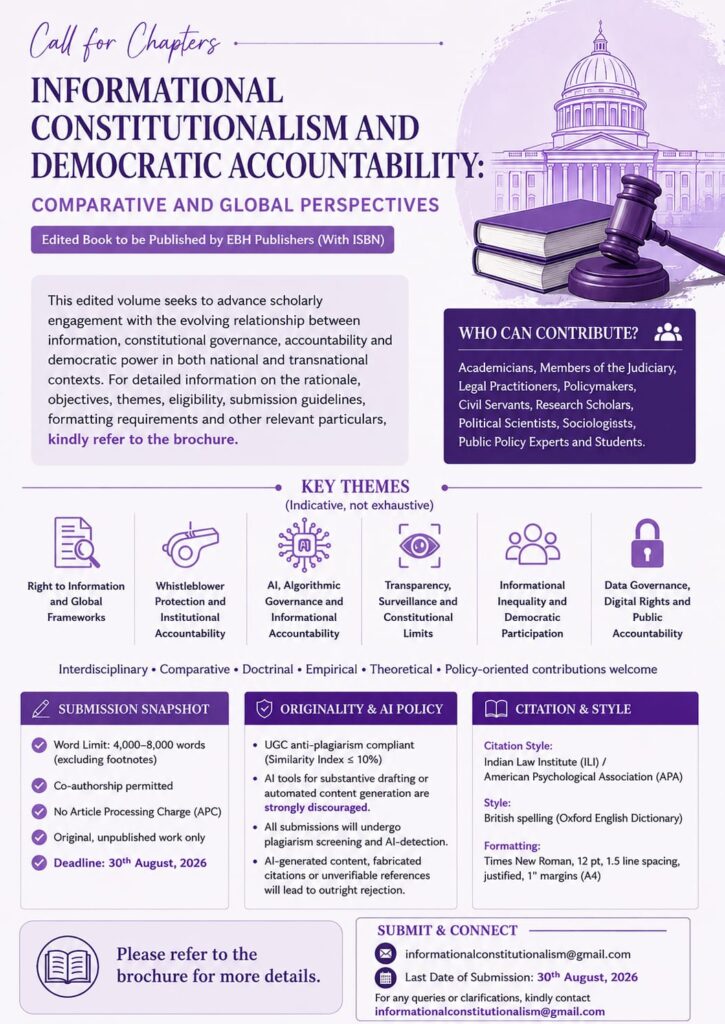
CALL FOR CHAPTERS
Edited Book to be Published by EBH Publishers (With ISBN)
The twenty-first century constitutional state is increasingly confronted by a profound paradox. While democratic governments continue to derive legitimacy from constitutionalism, public participation, rule of law and institutional accountability, the exercise of public power has simultaneously become increasingly opaque, technologically mediated, centralised and insulated from democratic scrutiny. Across jurisdictions, concerns surrounding executive secrecy, democratic backsliding, declining institutional trust, corruption, surveillance governance, algorithmic decision-making, information asymmetry and the erosion of public accountability have emerged as defining constitutional challenges of the contemporary era.
In this evolving constitutional landscape, transparency can no longer be viewed merely as an administrative value or procedural obligation. Rather, transparency has emerged as a foundational constitutional principle intrinsically connected with democratic legitimacy, rule of law, participatory governance, constitutional morality and institutional accountability. Correspondingly, the right to information, whistleblower protection, open governance frameworks and accountability institutions increasingly operate not as isolated legal mechanisms, but as structural safeguards against arbitrary exercise of public power.
Against this background, the proposed edited book, Informational Constitutionalism and Democratic Accountability: Comparative and Global Perspectives, seeks to critically examine the evolving relationship between information, constitutional governance, democratic accountability, institutional ethics and public power in both national and transnational contexts. Conceived as a rigorous interdisciplinary scholarly intervention, the book aims to bring together distinguished jurists, constitutional scholars, members of the judiciary, policymakers, civil servants, political theorists, sociologists, governance experts, public intellectuals and interdisciplinary researchers to collectively interrogate one of the defining constitutional questions of modern governance i.e. how should democratic societies regulate informational power in order to preserve constitutional accountability, democratic legitimacy and public trust?
The book seeks to move beyond narrow doctrinal understandings of transparency law and instead develop a broader framework of “informational constitutionalism,” recognising that access to information, institutional openness, disclosure obligations, accountability structures, democratic participation and governance ethics form integral components of the constitutional architecture of modern democracies.
The edited book shall be published with ISBN by EBH Publishers.
RATIONALE
Despite the substantial growth of scholarship concerning transparency, freedom of information, anti-corruption mechanisms, governance ethics, whistleblower protection and democratic accountability, existing literature remains significantly fragmented across disciplines, jurisdictions and institutional frameworks. Much of the contemporary scholarship continues to approach these issues through isolated doctrinal or policy-oriented lenses, often limiting analysis to statutory interpretation, administrative efficiency, or procedural governance concerns.
Existing studies on the Right to Information frequently remain confined to domestic legal frameworks without adequately engaging broader constitutional theory, comparative governance models, democratic legitimacy, or the structural relationship between informational access and public power. Similarly, scholarship on whistleblower protection often focuses narrowly on anti-corruption compliance without sufficiently examining institutional retaliation, constitutional morality, democratic dissent and ethical accountability within governance systems.
Further, contemporary academic discourse has not sufficiently addressed the rapidly transforming nature of informational governance in the digital age. Emerging concerns surrounding algorithmic opacity, artificial intelligence in public administration, digital surveillance architectures, predictive governance systems, biometric governance, data monopolisation, platform power, cybersecurity secrecy and automated decision-making increasingly challenge traditional assumptions surrounding transparency and accountability. Yet, these developments remain inadequately integrated within constitutional and governance scholarship.
Moreover, there exists a notable absence of a comprehensive interdisciplinary volume that systematically examines transparency and accountability through the combined lenses of constitutional law, political theory, sociology, public administration, democratic governance, institutional ethics, technology regulation, international law and comparative constitutionalism. Existing works often privilege either Global North experiences or narrowly domestic perspectives, thereby overlooking the distinct governance realities, institutional complexities and democratic struggles of Global South jurisdictions.
The proposed book seeks to address these scholarly deficiencies by developing a rigorous, theoretically grounded, interdisciplinary and comparative framework of informational constitutionalism. It aims to bridge doctrinal analysis with constitutional theory, governance studies, technological transformation, democratic ethics, institutional design and comparative public law. By bringing together eminent contributors from diverse disciplines and jurisdictions, the volume seeks to establish itself as a definitive scholarly reference work on transparency, accountability and constitutional governance in contemporary democracies.
The volume further intends to contribute to emerging global debates concerning democratic resilience, constitutional accountability, executive power, institutional trust and governance legitimacy in an era increasingly characterised by secrecy, informational asymmetry, technological centralisation and democratic uncertainty.
OBJECTIVES OF THE BOOK
The proposed book seeks to:
- Examine transparency as a foundational constitutional principle within democratic governance systems.
- Analyse the evolving relationship between information, constitutionalism, accountability and public power.
- Critically evaluate Right to Information frameworks from comparative and international perspectives.
- Explore whistleblower protection as a constitutional and democratic safeguard against institutional abuse and arbitrary authority.
- Investigate the relationship between transparency, rule of law, democratic legitimacy, institutional trust and governance ethics.
- Examine accountability structures across executive, legislative, judicial and administrative institutions.
- Analyse constitutional challenges posed by digital governance, artificial intelligence, algorithmic opacity, surveillance infrastructures and automated decision-making.
- Encourage interdisciplinary engagement across law, political science, sociology, governance studies, public administration, technology regulation and public policy.
- Contribute to emerging scholarship on informational constitutionalism and democratic accountability.
- Develop a globally relevant and academically authoritative reference work addressing contemporary governance challenges.
THEMATIC AREAS
The following themes are indicative and not exhaustive. Interdisciplinary, comparative, doctrinal, empirical, theoretical, socio-legal and policy-oriented contributions are strongly encouraged.
- Theoretical Foundations of Informational Constitutionalism
- Right to Information frameworks
- International Standards on Whistleblower Protection and Institutional Accountability
- Transparency and Democratic Institutions
- Technology, Data Governance and Algorithmic Accountability
- Comparative constitutional approaches to right to information
- Right to Information in the Age of Digital Governance Transparency, Surveillance, and the Constitutional Limits of State Power
- Digital Divide, Informational Inequality, and Democratic Participation
- Artificial Intelligence, Algorithmic Governance, and Transparency in Public Administration
- The “Black Box” Problem: Algorithmic Opacity, Automated Decision-Making, and Constitutional Accountability
- Algorithmic Bias, Data Discrimination, and Informational Justice
- Comparative Perspectives on Technology-Driven Governance and Digital Constitutionalism
- Cybersecurity, National Security, and Informational Rights in Constitutional Democracies
- Data Governance, Platform Power, and Public Accountability
- Biometric Governance, Digital Identity Systems, and Civil Liberties
- Predictive Governance, Automated Statecraft, and Democratic Oversight
ELIGIBILITY
The edited book invites original and high-quality contributions from academicians, members of the judiciary, legal practitioners, policymakers, civil servants, researcher scholars, political scientists, sociologists, public policy experts, international law scholars and students.
Contributions engaging comparative, interdisciplinary, empirical, doctrinal, theoretical, socio-legal and policy-oriented perspectives are particularly encouraged.
SUBMISSION GUIDELINES AND STYLE REQUIREMENTS
- Submissions must be original, unpublished and not under consideration for publication elsewhere.
- Co-authorship is permitted.
- No article processing charge
- Contributors may adopt doctrinal, comparative, empirical, interdisciplinary, theoretical, socio-legal, or policy-oriented methodologies.
- All submissions shall undergo editorial screening and peer review. The shortlisted contributors shall be duly informed by the Editorial Board.
- Mere submission of a manuscript shall not confer any claim for publication.
- The Editorial Board reserves all rights relating to the acceptance, rejection, editing and publication of submissions.
- The decision of the Editorial Board regarding interpretation of guidelines or any other matter concerning publication shall be final.
- All submissions must strictly comply with UGC anti-plagiarism regulations. The permissible similarity index shall not exceed 10%.
Word Limit
- The manuscript shall be between 4000–8000 words, exclusive of footnotes.
Originality and AI Policy
- All submissions must be original and reflect independent academic research and writing.
- The use of Artificial Intelligence tools for substantive drafting, automated content generation, or unsupervised manuscript preparation is strongly discouraged.
- All submissions shall undergo rigorous plagiarism screening as well as AI-detection scrutiny by the Editorial Board.
- Any submission found to contain AI-generated content, excessive AI-assisted writing, fabricated citations, or unverifiable references shall be liable to outright rejection without further review.
- The Editorial Board reserves the right to reject any manuscript that fails to satisfy standards of originality, authenticity, academic integrity and scholarly rigour.
Style Guidelines
- Authors shall use British spelling in accordance with the Oxford English Dictionary. For instance, ‘labour’ shall be preferred over ‘labour’, ‘recognise’ over ‘recognize’ and ‘standardise’ over ‘standardize’.
- Authors are encouraged to maintain high academic rigour, analytical clarity and originality consistent with internationally reputed scholarly publications.
Citation Format
- The author(s) shall strictly follow the Bluebook: A Uniform System of Citation (20th Edition) for citation and referencing.
- Authors may additionally consult the Oxford Standard Citation of Legal Authorities (OSCOLA) for guidance regarding legal citation practices and source referencing consistency.
Formatting Requirements
- Main headings shall be in ALL CAPITALS and in bold.
- Sub-headings shall be in bold with only the first letter capitalised.
- First-level headings shall be numbered as 1, 2, 3 and so on.
- Second-level headings shall be lettered as A, B, C and so on.
- Third-level headings shall be numbered as (i), (ii), (iii) and so on.
- Submissions shall be typed in Times New Roman, font size 12, with 1.5-line spacing, justified alignment and 1-inch margins on all sides of an A4 sheet.
- Footnotes shall be in Times New Roman, font size 10, with single line spacing.
- Page numbers shall be centre aligned at the bottom of each page.
- Graphics, charts, tables, diagrams and illustrations shall be numbered consecutively and incorporated within the main body of the manuscript.
- Quotations shall use single quotation marks. Double quotation marks shall be used only for quotations within quotations.
- In case of references from websites, the complete URL along with the last date of access must be provided.
Submission Procedure
- Submissions must be emailed to: [email protected]
Contact
For any queries or clarifications, kindly contact [email protected]